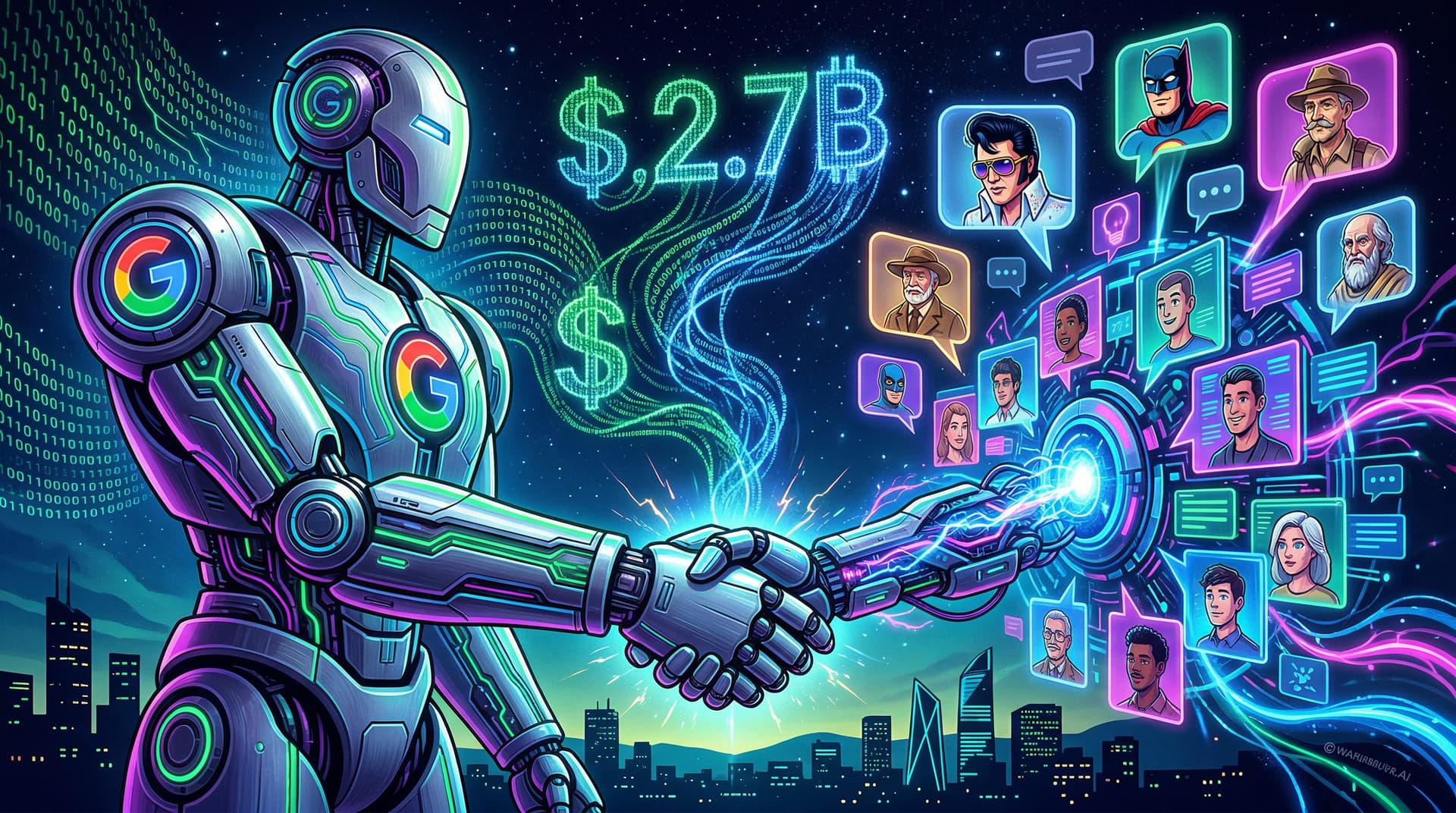
In a move that underscores the cutthroat competition for artificial intelligence talent, Google is reportedly in advanced discussions to hire the co-founders of hot AI startup Character.AI for approximately $2.7 billion. The deal, first reported by The Information on January 25, 2024, would see Google DeepMind recruit Noam Shazeer and Daniel De Freitas, two former Google engineers who left the tech giant in 2021 to start Character.AI. Under the proposed terms, Google would license Character.AI's conversational AI technology, while the startup would continue to operate independently.
This arrangement echoes Microsoft's recent hiring of Inflection AI's leadership—though that deal was announced later—but it signals Google's aggressive push to bolster its AI capabilities amid pressure from rivals like OpenAI and Anthropic. As of January 29, 2024, the talks remain ongoing, with no official confirmation from either company.
The Rise of Character.AI
Character.AI burst onto the scene in late 2022, quickly amassing millions of users with its innovative platform that lets people chat with AI personas modeled after historical figures, celebrities, and fictional characters. Founded by Shazeer, a co-inventor of the Transformer architecture that powers modern large language models, and De Freitas, the startup raised $150 million in a Series A round in March 2023 at a $1 billion valuation. Investors included the ubiquitous a16z (Andreessen Horowitz) and other prominent VCs betting big on conversational AI.
The app's appeal lies in its uncensored, highly engaging interactions—users can role-play with AI versions of Elvis Presley, talk philosophy with Socrates, or even create custom bots. By mid-2023, Character.AI had surged to the top of app store charts, particularly among teenagers, sparking concerns from parents and regulators about inappropriate content and excessive screen time. In November 2023, the company introduced safety filters and parental controls in response to scrutiny.
Despite its rapid growth, Character.AI has operated in a resource-constrained environment compared to giants like OpenAI. With a team of around 50 employees, it has focused on rapid iteration and user feedback to refine its models. Shazeer, often credited as a pioneer in AI, previously led Google's Transformer team and launched his own startup, Everyday Robots (acquired by Google in 2022).
Deal Details and Strategic Implications
According to sources familiar with the matter, the $2.7 billion figure represents compensation to Shazeer and De Freitas, potentially structured as cash, stock, and other incentives. Google would gain access to Character.AI's proprietary models and data, integrating them into products like Gemini, its flagship AI chatbot launched in December 2023.
This isn't a full acquisition; Character.AI's remaining team and IP would stay intact, allowing it to pursue commercial opportunities independently. It's a savvy structure that avoids antitrust headaches while securing top talent—Google has faced regulatory scrutiny over past deals.
For Google, the move addresses a talent gap. CEO Sundar Pichai has repeatedly emphasized AI as the company's top priority, investing billions in data centers and chips. Hiring Shazeer and De Freitas brings back homegrown expertise, potentially accelerating advancements in multimodal AI and personalized interactions.
"This is part of a broader trend where Big Tech is willing to pay astronomical sums for AI innovators," said a16z partner Martin Casado in a recent podcast. "Startups like Character.AI prove you don't need massive funding to build something world-changing."
AI Startup Talent Wars Heat Up
The proposed deal fits into a pattern of 2024's AI landscape, where startups serve as talent incubators for hyperscalers. Just weeks earlier, in early January, Perplexity AI closed a $74 million funding extension at a $520 million valuation, fending off acquisition interest. Meanwhile, French startup Mistral AI achieved a $6 billion valuation post-funding in late 2023, drawing comparisons to OpenAI's trajectory.
Other notable January moves include Harvey AI's $80 million Series B on January 23, valuing the legal AI specialist at $715 million, and Moonvalley's $12 million seed for video generation AI. Yet, the Character.AI talks highlight a shift: founders cashing out big without selling the company.
Critics worry this stifles innovation by funneling talent back to incumbents. "It's a brain drain for startups," noted analyst Benedict Evans in a January 26 tweet. "Founders build, Big Tech buys the people—not the tech." Supporters argue it validates the startup model, providing liquidity and scaling opportunities.
Character.AI's challenges persist: competition from ChatGPT's custom GPTs, Grok from xAI, and Claude from Anthropic. Monetization remains nascent, relying on premium subscriptions at $9.99/month.
Broader Impact on Startups
For the startup ecosystem, this deal could set a precedent. Valuations in AI have skyrocketed—Scale AI hit $14 billion in May 2023—but 2024 has seen funding slowdowns outside generative AI. CB Insights reported $4.2 billion in AI investments for Q4 2023 alone, with early 2024 maintaining momentum.
Startups must now weigh independence against lucrative buyouts. Founders like those at Adept or Runway ML face similar overtures. Investors, too, benefit: a16z's stake in Character.AI could yield massive returns without a full exit.
Regulators watch closely. The FTC and EU have signaled tougher scrutiny on AI deals, fearing monopolization. If finalized, this transaction might invite review, especially post-Microsoft-Activision.
Looking Ahead
As AI hype peaks, deals like this redefine success. Character.AI's journey—from garage project to $2.7 billion talent magnet—embodies the sector's dynamism. Google gains a competitive edge, but the real winners may be entrepreneurs proving Big Tech's checkbook can't buy everything.
Stay tuned: with AI advancing weekly, January 2024's talent shuffle foreshadows a year of consolidation. For startups, the message is clear: build fast, talent is king.
Word count: 912