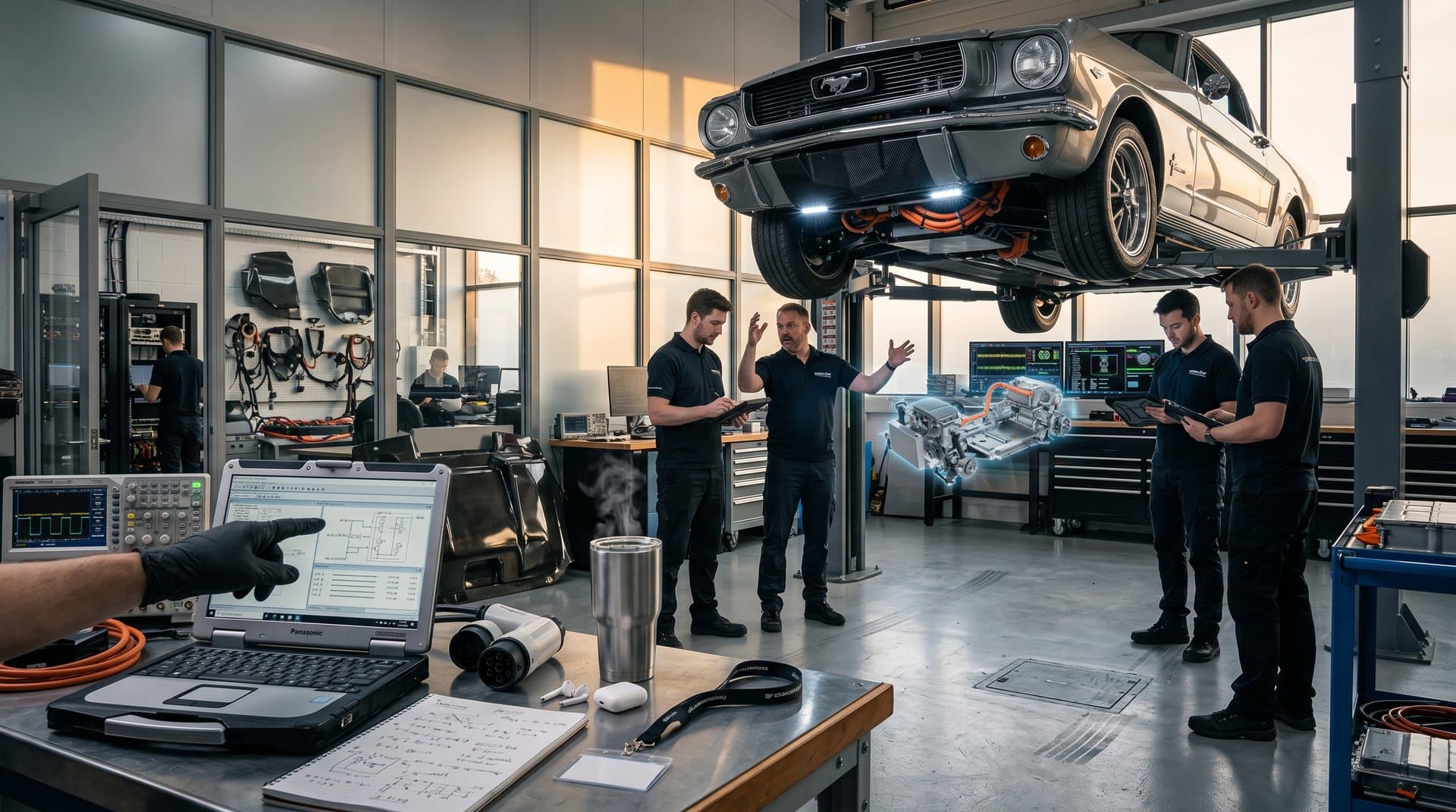
- Calimotive built 1966 Ford Mustang Tesla conversion for USD 40,000 in two years.
- 400 horsepower powers 3.5-second 0-60 mph acceleration.
- 258 Wh/mi efficiency enters USD 5.9 billion global EV market.
Calimotive Auto Recycling completed a 1966 Ford Mustang Tesla conversion with Full Self-Driving (FSD) capability for USD 40,000 on May 2, 2024 (PDT). Yaro Shcherbanyuk's Sacramento shop integrated a Model 3 dual-motor drivetrain. It delivers 400 horsepower, 471 lb-ft torque, and 258 Wh/mi efficiency. A 15-inch touchscreen controls FSD, as Electrek reports details.
Shcherbanyuk bought the Mustang on Facebook Marketplace in summer 2022. His father Viktor and brother Daniel helped source parts from Calimotive's Tesla and Rivian inventory. The build hits 0-60 mph in 3.5 seconds.
Model 3 Drivetrain Powers 1966 Ford Mustang Tesla Conversion
Engineers swapped the Model 3 floorpan and seats into the chassis in 2024. Dual motors provide instant torque exceeding the original V8's 300 lb-ft. Open-source tools confirmed FSD cameras and Full Self-Driving computer compatibility.
The drivetrain achieves 258 Wh/mi efficiency, matching Tesla specifications. FSD enables vision-based highway autonomy. "It performs reliably on California roads," Shcherbanyuk told Electrek.
- Metric: Horsepower · Original 1966 Mustang: 200-300 · Converted Tesla Mustang: 400
- Metric: Torque (lb-ft) · Original 1966 Mustang: 300 · Converted Tesla Mustang: 471
- Metric: 0-60 mph (seconds) · Original 1966 Mustang: 8-10 · Converted Tesla Mustang: 3.5
- Metric: Efficiency · Original 1966 Mustang: N/A (gas) · Converted Tesla Mustang: 258 Wh/mi
Data from Shcherbanyuk's logs and Tesla specifications.
Full Self-Driving Boosts Global Classic Car EV Conversions
FSD handles hands-free driving on mapped roads across North America, Europe, and Asia. Calimotive calibrated sensors for the Mustang body. The screen shows live AI visualizations, merging retro style with advanced autonomy.
Tesla's over-the-air updates from Gigafactories in the US (Texas, Nevada), Shanghai, and Berlin ensure updates. Parts flow through supply chains from Vietnam factories to Rotterdam ports and US hubs.
Europe's 2035 zero-emission rules from the EU Commission spur demand. Asia-Pacific air quality standards add pressure. International Energy Agency (IEA) data shows EV conversions rising 25% yearly in these regions.
USD 40,000 Build Taps USD 5.9 Billion EV Conversion Market
Grand View Research values the global vehicle-to-EV conversion market at USD 5.9 billion in 2024. It projects USD 15 billion by 2034. Ford CEO Jim Farley highlighted EV shifts in Q1 2024 earnings call (NYSE: F).
"Classics gain modern performance without losing heritage," Shcherbanyuk stated. Calimotive undercuts new EV prices like Tesla Model 3 (USD 40,000 base) while retaining collector appeal. UN climate goals accelerate uptake from Europe to Asia-Pacific.
Battery costs fell 15% yearly through 2023, per BloombergNEF. Investors target conversions as lithium prices stabilize. Shops in Detroit, Rotterdam, and Shenzhen prepare replicas tied to Australian and Chilean supply chains.
Regional Markets Drive 1966 Ford Mustang Tesla Conversion Demand
Europe leads with USD 2.1 billion in conversions, fueled by Germany's KBA regulations and UK's ZEV mandate, per McKinsey. Asia-Pacific grows 20% annually to USD 1.8 billion by 2030, with subsidies in India (INR 1.5 lakh per vehicle) and Japan.
Latin America emerges via Brazil's ethanol-to-EV shifts, hitting USD 500 million. Africa's solar-battery integrations in South Africa add USD 200 million. IMF reports link these to USD 300 billion global lithium trade.
China retrofits 10,000 classics yearly under WHO standards, says CAAM. Tesla FSD adapts to US highways, European autobahns, and Asian urban roads. Ford's legacy fuses with Tesla AI for emerging market retrofits.
Finance and Trade Fuel Worldwide EV Retrofit Surge
EU MiCA rules ease crypto payments for parts imports. Lithium output from Chile (50% global), Australia (25%), and Indonesia rises 12% in 2024, per USGS. Calimotive's USD 40,000 model inspires USD 1 billion in replication investments.
Venture capital flows USD 500 million to conversion startups in 2024, PitchBook data shows. This 1966 Ford Mustang Tesla conversion signals tech-finance disruption across borders, with 25% CAGR projected through 2030.
Frequently Asked Questions
What is the cost of the 1966 Ford Mustang Tesla conversion?
Calimotive spent USD 40,000 over two years using Model 3 parts for 400 hp and 258 Wh/mi efficiency.
How does Full Self-Driving function in the converted Mustang?
FSD cameras and computer mount on the chassis. The 15-inch touchscreen enables hands-free highway driving.
What is the global EV conversion market size?
Grand View Research values it at USD 5.9 billion in 2024, growing through 2034 amid regulations.
What performance upgrades does the Model 3 drivetrain provide?
Dual motors deliver 471 lb-ft torque and 3.5-second 0-60 mph, surpassing the original Mustang.